
What does it take to be a Coach?
Table of Contents
What does it take to be a self-employed professional coach who relies on their own ingenuity and dedication to put food on the table every month? What inspires someone to take that path? What is involved? How much does “real” coaching match to the pure coaching promoted by the International Coaching Federation?
If you’re considering switching careers to be a freelance coach and/or you’re considering stepping out from under a corporate 9-5 umbrella, this research might just be for you.
While studying at the ICA (International Coach Academy), I interviewed 6 professional coaches from various walks of life to help understand the coaching profession, with the ultimate aim of answering one fundamental question: “Do I really want to be a coach?”.
Path to Coaching
The coaches interviewed came from wide and varied backgrounds and sometimes had careers spanning various industries and skill sets.
SW was a former area director at Microsoft. As well as coaching and consulting, SW is a writer and university lecturer.
HG has been a professional actor for over 10 years and is also a trained Zumba instructor. She has a postgraduate qualification in teaching, and focused on learning & development in the corporate space.
JM has an illustrious marketing background in FMGC (Fast Moving Consumer Goods) and the banking sector. JM had already made the switch to freelance consultant before becoming a coach.
SK was an Associate Director of Regulatory Affairs before switching to a career of coaching, training and mentoring.
PM was a successful sales manager for a leading financial services company.
SB was most recently head of region for a large mobile operator and has held various senior leadership roles.
The catalyst to become a professional coach varied widely too. Some coaches were inspired by positive coaching experiences, some were praised for their coaching skills in previous jobs. Some wanted to formalize their existing skills. Some took the step after life-events prompted a career rethink.
“[every time I coach, it] refills me with joy and satisfaction, and less and less I want to go back to corporate life in my previous role [...] it took a long time [...] But at a certain point I thought, Okay. I'm just gonna go with the full blown thing and started, you know, working on a logo and my brand and my website.”- SK
“I was actually inspired by many of my previous reports. I was being told by them Sinyi, you are so good at coaching! [...] I had 2 years being coached by 2 executive coaches, they also inspired me to be a coach.” - SW
As to moving to freelance from 9-5, some made the move for greater work-life balance.
Most ICA interviewees had been coaching informally for years before deciding to seek formal qualifications:
“I have actually been coaching for a couple of years, maybe a bit longer [..] but it's never been formalized” - HG
“I was a consultant. I was a coach without knowing that I was coaching.[..] even in the consultant part, [...] I'm not used to [giving answers…] it's always probing. [...] What are the challenges? So the whole SWOT analysis, and [...] gap analysis without giving directly the strategies or the recommendation.[...] I was noticing a bit of coaching and a bit of mentoring.” - JM
Coaching Approach
A few coaches noted that the pure coaching style taught by ICA is often not possible in a corporate setting:
“The kind of coaching here [at ICA] is very different from corporate coaching. because, you know, in the fast paced environment, pure coaching? it's too challenging to move the team forward. [...] For example, a very extreme example, like lay off. Nothing we can coach. [...] it's all about accompanying people to walk through the journey, and at that moment people don't want you to ask questions. It’s just give me your empathy, cry with me” - SW
“It's a lot of mentoring slash coaching, so I call it ‘mentching’. [...] I prefer pure coaching but in Associations it's very often a combination of the two.” - SK
“And you know these leadership roles. And you say coaching, you're not really coaching. It's probably more mentoring. So I think learning the pure, coaching way. I really loved it. And actually it is what I do. The only thing that adds a slight variance to it is the Clifton strengths. [...] they'll ask a question about a particular strength to try and help to understand it. [...] that's the only time I really information give” - SB
All coaches offer coaching in combination with other services, like workshops, consulting, mentoring or training.
“I offer workshops full day, half day workshops, and or multiple days. [It] depends. [...] So if we focus on menopause in the workplace, I offer that from a creating awareness, an educational perspective, training” [hg0]
Defining the Niche
Coaches tend to define their niches based on strengths and experience. Specialization is seen as important to stand out. Sometimes coaches adjust their niche based on market demand.
“I already have my expertise which is the strategic marketing side either in an FMCG Industry or in a service industry so [...] being specialized in a certain industry or in a certain field can help because you'll be different from a general consultant.”- JM
“So I [...] have a niche of helping people deal with change and uncertainty. Main reason being is because [...] I spoke to lots of people that have worked with me closely and [...] lots of it came back to confidence because it was like anything you ever did gave me real confidence.[...] you were never afraid to take a risk, you'd always be doing things differently. So I thought, you know what that is? Change. So it's something that I kind of excel at. It fits to my top Clifton strengths, and it also aligns closely to my values.” - SB
“It's been a very long journey. [...] I started [...] doing management development leadership training [...] the best part of 10 years. [...] I could do most things, but I wasn't recognized for anything. [...] To create more value [...] I needed to specialize more. [... There was…] a shift in the marketplace as well, because [over time] they were less inclined to spend money on group stuff but more inclined to spend money on individual leaders who wanted support.” - PM
Client Acquisition and Marketing
Word-of-mouth is by far the most recognised tool for growing a coaching business. Making and nurturing relationships over the long term is important to succeed.
“It started happening via word of mouth where friends would recommend me for a paid gig as a coach.” - HG
“mostly the clients come from word of mouth.” - SW
“I've been very used to playing the long game with stuff. [...] if I sow a seed with somebody, it might take 6 months for that to come to fruition. [...] I've got half a dozen who I'm speaking to who I know will be ready when they're ready.” - PM
“there's lots of different funnels but ultimately they're all pretty slow burners. The main one is the previous network: people that I've worked with and people that have worked for me because they're sort of family. [...] you get the conversation from those people, which is great. [...] The next one down is people that you've worked with, but probably haven't kept in contact with so much or aren't in such senior decision making positions, but are still in HR, or senior Ops roles.” - SB
LinkedIn was seen as more effective than a website but still not likely to generate business on its own. Websites were seen as secondary to LinkedIn.
“I see Linkedin as the first step to a website. For me, it's like a mini website because first of all, it's the first step to introduce yourself to a network, to an audience. It is a general one. You're not targeting here.” - JM
“The first thing they look at [is] your Linkedin before they look at your website. So if you're posting good content on Linkedin, that's [...] relevant to what you do and tells a little bit about you that becomes powerful.” - SB
Networking events were seen positively by some coaches and negatively by others.
“People don't have needs when you need them to have needs. It just doesn't work like that.” - PM
“Networking is super important because you tend to get to know new people. [...] it's like a sales call and a cold call. [Out of 10 prospects] at the end of the day [maybe] one client is actually converted into a real client.” - JM
Doing the Work, Staying Present
There is a fair amount of behind-the-scenes work that goes with maintaining a coaching business, mainly around client relationships and lead generation. Paperwork is only a small part. None of the coaches interviewed use a dedicated coaching platform. Most coaches use simple tools to help with payments and scheduling.
“[For me] there was a bit of underestimation about the volume of other stuff you've got to do in order to get clients coming in.” - SB
“There'll be a splattering of coaching. Then it will be a proposal to be written. So I've got to research that. There will be some research for coaching sessions. There'll be follow up for coaching sessions. And there will be keeping in touch with people. [...] [As for administration] it's minimal to be fair. I mean, one of the things I love about what I do is [...] it's light on lots of things: I don't have a big kit bag, I don't need a big office. I literally need this [laptop] and my brain.” - PM
When asked how coaches maintain their energy and presence for clients, several coaches said they took time out for personal pursuits.
“I've always been pretty good at keeping my own stuff sort of away [but] I've got an active brain, so I have to switch it off sometimes. One of the ways is [...] reading [...] taking the dog out for walks [...] having a solitary coffee in the morning.[...] tomorrow I'm taking a whole day out, and we’ll go hiking in the mountains. So it's things like that. Make the most of the flexibility that you can create.” - SB
“There's a lot of time that I learned from mistakes and trial and error. I realized the way that really helped me a lot is to be by myself, even doing nothing. So writing a column is energy charging for me and then every time when I do a lecture, I will need quiet time including, but not limited to, sleeping.” - SW
Professional Development and Growth:
When asked about learning and growth, SW referenced the adult learning 10-20-70 model:
10% from books/courses on coaching
20% from peers/mentors feedback on coaching
70% on the job - coaching real clients or peer coaches
All coaches interviewed have done some form of training or certification connected with coaching. The majority have ICA qualifications, most are ICF accredited, some are qualified assessment tool practitioners e.g. Clifton Strengths, or Emotional Behaviour At Work. Reading is a common theme.
“I do a lot of self-learning, and I do a lot of research [...] by nature. I'm curious. [...] So you get to be up to date with what's happening. And also you get to be in the loop with what's happening with yourself as a coach and what you could be, continuously learning.” - JM
“I think in terms of the future.[...] I'm 25 years in. [...] I have to remain relevant, and I have to find ways to remain relevant. And I think that's key. So you have to keep up with stuff [...] Many [clients] are 15-20 years younger than me, whereas I was 15 years younger than them once.” - PM
Advice to Newcomers
SW recommends the Ikigai framework as a guide for career path decisions.
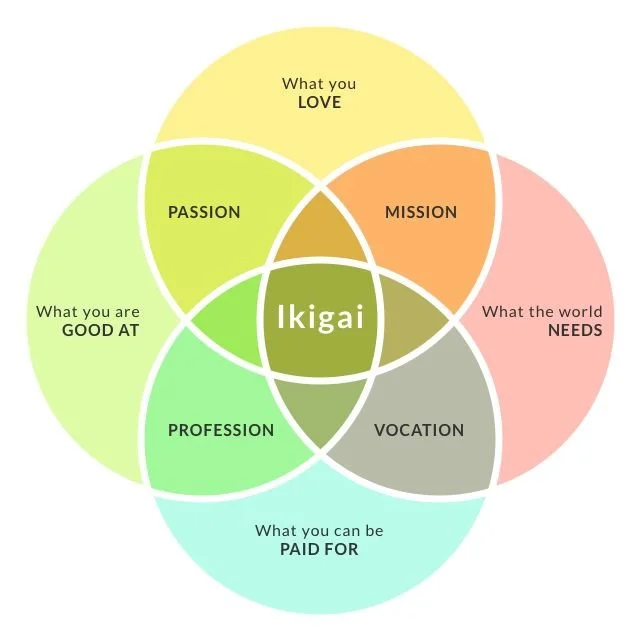
“before I chose to start up [company], there was a thing I did to coach myself. I did my own Ikigai. [...] For all the coach this is something that they [should do … ]”
SW
SB and HG encourage coaches to reach out to their peers and take full advantage of peer coaching.
“The power is to talk to as many people in the coaching community as possible. [...] next big bit of advice is don't try to be a perfectionist, just get things good enough, because if you wait for perfection and you start comparing what you're doing to everyone else, you're never going to do it. [Also] peer coaching [...] It's such an awesome resource.” - SB
“There are so many people out there in the world that have different ways of thinking that I haven't thought about yet, or or might challenge my thinking, [I might say] I don't know if I agree with that, but then you go away and you think about it.” - HG
PM encourages people looking to make the change, to consider how much they want it and what support network they have. SB had similar advice about checking the level of desire to overcome challenges.
“If I look back at the trajectory I've taken. I'd have said, you silly [fool] don't bother… [but] I've had a great life. I'm enjoying it. [...] I persisted and I think if it's important enough, and you want to do it enough, you will always find a way [...] trying to go out on your own is a risk [...] it's important that you have a decent network of people around you. [...] who would be the first 10 people I'd ask help from? [...] If you've got the cover of a 9 to 5, then maybe [...] find some opportunity to do some stuff voluntarily for a bit [first].” - PM
“If you want it enough. you'll do it. If something's holding you back then you probably need to question whether you really want to do it.” - SB
Conclusion
In this research, I set out to answer the question of what it means to be a coach.
There were a few common themes:
Deep inner-belief that coaching is the right thing to do for them. That inner belief has driven them to overcome challenges and to put in the work necessary to succeed.
Authentic human connection driving word-of-mouth referrals, offering support to maintain a healthy work-life balance, and spurring continuous learning through expert & peer connections. All the coaches interviewed were natural networkers.
High levels of achievement were present in the coaches prior careers. This is arguably a testament to their soft skills as well as work ethic and drive.
Blended offerings were the norm. Even coaches who prefer pure (non-directive) coaching offer complementary services such as personality assessments, training or mentoring to increase appeal.
Word-of-mouth is by far the most successful means to build and maintain a coaching business.
Specialization over generalization. A niche is necessary to stand out, to be remembered. How do you get referred via word-of-mouth if your service is not memorable?
This investigation also set out to answer the deeply personal question of “Do I really want to be a coach?”. My conclusion is a resounding YES with a single caveat: I need to employ some hacks to boost my networking ability.
What about you? What’s your conclusion?
While You’re Here…
Enjoyed this article? Please get in touch. I’d love to hear from you.
Meet The Coaches
SW - https://pmlab-makeithappen.com/
SB - https://blackflagcoaching.com/
PM - https://www.thementalmusclecompany.com/
JM - https://www.linkedin.com/in/joumanamazloum/
SK - https://www.shirleyskcoaching.com/
About the author
I’ve spent the last 30 years of my professional life as a business employee. Except for a few hiccups, I’ve had a predictable paycheck all that time. Coaching as a profession, especially when self-employed, was something curiously alien to me when I began this investigation.
Research process
I designed an interview script to collect similar qualitative information from each interview.
It proved challenging to secure interviews with coaches and arrange appointments in a reasonable timescale. In the end, I conducted 6 one-hour interviews via Zoom over a 3 month period. 5 coaches were fellow ICA students with coaching businesses. One was a coach I met through work.
From this base research, I analyzed findings using Google NotebookLM to pull out the major themes from the transcripts and my notes. I then wrote the paper by hand, using Google NotebookLM’s source links to help pinpoint relevant quotes in the original transcripts.
